


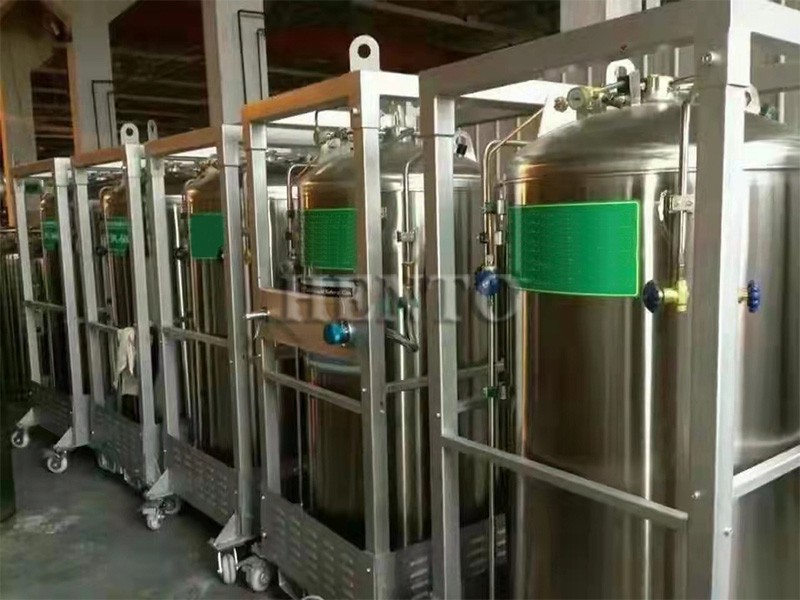
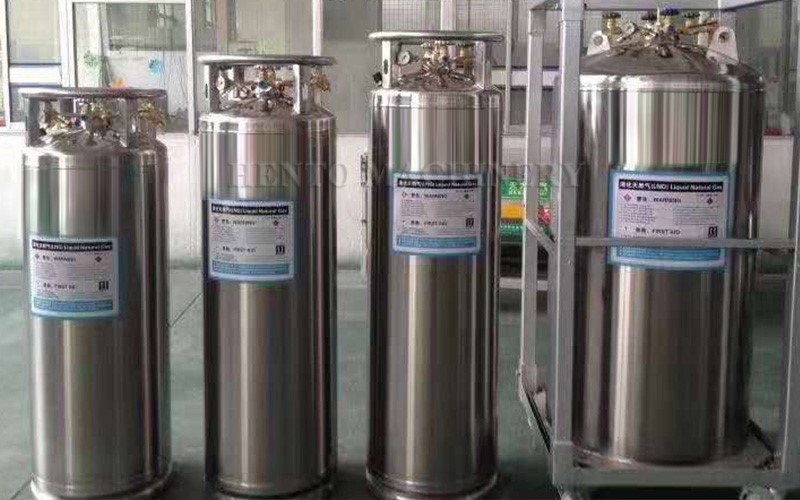
The main structure and various component functions of Dewars(Co2 Tank Storage vacuum) are as follows:
Outer cylinder: In addition to protecting the inner cylinder, it also forms a vacuum interlayer with the inner cylinder to prevent the invasion of heat from outside the bottle and reduce the natural vaporization of low-temperature liquid inside the bottle;
Vaporizer
By exchanging heat with the inner wall of the outer barrel, the liquid gas inside the bottle is transformed into a gaseous state;
Liquid valve
controls the filling or discharge of liquid from the Dewar bottle;
Safety valve
When the pressure of the container exceeds the larger working pressure, it automatically unloads the pressure, and its jumping pressure is slightly greater than the larger working pressure;
function
Inner cylinder: Reserve low-temperature liquid;
Discharge valve
When filling a Dewar bottle with liquid, use this valve to discharge the gas in the gas phase space inside the bottle, reduce the pressure inside the bottle, so as to quickly and smoothly fill the liquid. Another function is that when the pressure inside the Dewar bottle exceeds the higher working pressure during storage or other situations, this valve can be used to manually discharge the gas inside the bottle to reduce the pressure inside the bottle;
Pressure gauge: indicates the pressure of the cylinder inside the bottle;
Use valve: used to open the pipeline passage between the liquid vaporization circuit of the Dewar bottle and the user's gas inlet end, and can also be used to control the gas flow rate;
Boosting valve
After this valve is opened, the liquid inside the cylinder will undergo heat exchange with the outer cylinder wall through the boosting coil, vaporize into gas, and enter the gas phase space at the upper part of the inner cylinder wall, establishing a certain driving pressure (internal pressure) for the cylinder to drive the low-temperature liquid inside the cylinder and make it flow;
Liquid level gauge: It can visually indicate the height of the liquid level in the container, and the installation position should be convenient for operators to observe and maintain.
FAQ
Q: What's the MOQ?
Q: Can the machine be customized?
Q: What's the payment term?
Q: How to ship?
Q: Which port do you send the goods from?
Q: How long is the warranty of the machine?
Q: How to buy this machine?
Q: What about the package?
Q: Do you need a supplier to provide transportation?
Q: Are there any requirements for power supply?
Q: What about Pre-sale service:
Q: What about After-sales service?


